


Bible Bff-Modern Bible Stories
Idea Garden LLC
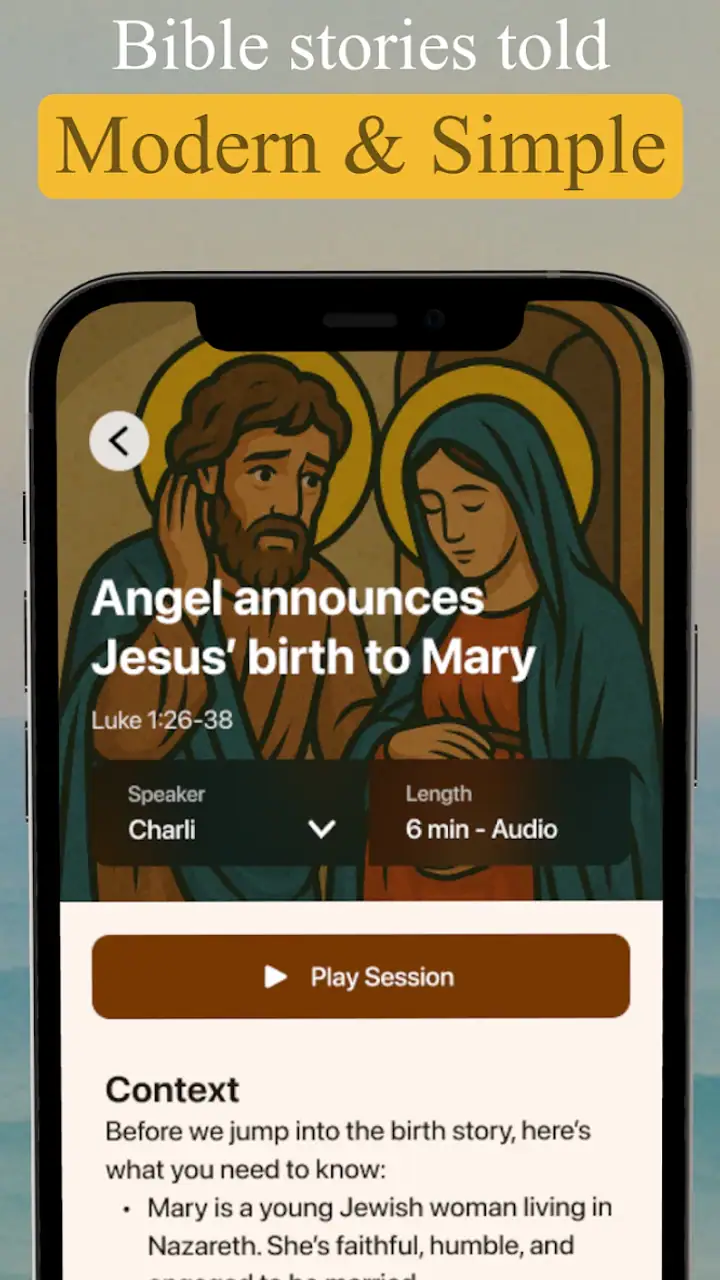
I approached Bible Bff-Modern Bible Stories as a reading companion rather than as a replacement for a full study Bible. That distinction matters. The app sits in the Books & Reference category, comes from Idea Garden LLC, and presents itself as a friendlier way into biblical stories for people who may find traditional study difficult to begin. My overall impression is that its biggest opportunity is reducing the emotional and practical friction around opening the Bible, while its biggest challenge is making sure that simplicity does not become too limiting for readers who need deeper context.
The app is free to install and is rated for Everyone, which makes it approachable for households, younger readers, casual learners, and people returning to Bible reading after a long break. It includes optional in-app purchases priced from $6.99 to $59.99 per item, so I would treat the free experience as a chance to understand the reading style before spending anything. Its current version is 19.0, and it runs on Android 7.0 or later. Those details make it reasonably accessible from a device-compatibility point of view, although the experience still depends heavily on how comfortable each person is with reading on a phone or tablet.
Readability and navigation shape the first impression
The most important design question for this kind of app is not whether it contains a large amount of material. It is whether a person can open it, understand what to do next, and keep reading without feeling lost. Bible Bff-Modern Bible Stories is aimed at that first step. I found the concept more inviting than opening a conventional Bible app full of translations, cross-references, reading plans, study notes, and menus before I have even chosen a passage.
That lighter approach can be especially useful for readers who are intimidated by unfamiliar names, long chapters, or the expectation that they should already understand biblical language. A modern retelling can provide a gentler entry point, particularly when someone wants the broad story before examining the original text. In practical terms, I would recommend starting with a short, regular session rather than trying to cover a large amount at once. The app makes more sense as a habit-building tool than as a reference shelf.
Readability is also about mental load. A reader with dyslexia, attention difficulties, limited working memory, or limited experience with religious texts may benefit from a straightforward presentation. Shorter story-focused reading can make it easier to remember what happened and why it matters. I would still check the text personally before sharing it with a child or using it in a group, because “modern” language can make a passage easier to follow while also shaping how its meaning is understood.
Related News

Why WhatsApp Messenger Still Makes Everyday Communication Feel Easy

Jurassic World: The Game Is the Better Dino Tycoon for Strategic Players

Threads in Real Life: Who Should Join, Lurk, or Leave

How SHEIN Turned Shopping Into an Endless Content Feed

How to Make Fortnite Feel Smarter on Mobile

Should You Switch to Microsoft Outlook on Mobile?
One useful workflow is to separate discovery from study. I would use the app to identify a story that interests me, read it without trying to solve every question immediately, and then move to a traditional Bible or trusted reference when I need exact wording, historical background, or comparison between translations. That two-stage method avoids asking one small app to perform every job. It also helps readers who become discouraged when a study Bible presents too much information at once.
Why a story-first format can help hesitant readers
Many people do not avoid the Bible because they lack curiosity. They avoid it because the first experience feels like homework. Names, locations, customs, repeated genealogies, and unfamiliar expressions can make the opening minutes tiring. Bible Bff-Modern Bible Stories addresses that emotional barrier by making the material feel more conversational and approachable. For a friend who says, “I want to understand the Bible, but I do not know where to start,” this is the kind of format I would suggest trying first.
There is a trade-off, though. A simplified story is not identical to the source text. Readers should not assume that an easy retelling includes every detail, emphasis, or ambiguity found in scripture. If accuracy at the wording level is the priority, a conventional Bible app is the better first choice. If confidence and comprehension are the priority, this app has a more welcoming role.
Gallery
Navigation advice for different reading habits
I would approach the app differently depending on the reader. Someone with a clear goal, such as locating a specific verse or comparing translations, will probably feel more at home in a standard Bible reference app. Someone who wants a guided way to encounter familiar and unfamiliar stories may find this format less demanding. Families can also use it as a conversation starter, but I would keep the discussion open-ended rather than treating the retelling as the only possible interpretation.
For users with attention challenges, a practical routine is to choose one story, read it in a quiet moment, and write down one question afterward. That prevents the session from turning into endless scrolling or passive consumption. For users who prefer predictability, repeating the same reading time and location may be more helpful than searching for new material every day. The app’s value is strongest when it lowers the threshold for returning tomorrow.
Motor, sensory, and situational access
Using any reading app involves more than understanding the words. It requires tapping, scrolling, holding a device, focusing on a screen, and coping with the surrounding environment. Bible Bff-Modern Bible Stories can support a range of situations simply because it places Bible stories on a mobile device, but that should not be confused with a guarantee that every interaction will suit every ability.
For readers with limited fine-motor control, the main question is how much precise tapping the experience demands during ordinary reading. A story app is most comfortable when the reader can move through content with broad, uncomplicated gestures rather than repeatedly targeting small controls. I would test it with the device held in the position that causes the least strain. A stand can be useful for someone who cannot comfortably hold a phone for long periods, while a larger tablet may reduce the need for constant zooming or repositioning.
People with tremors, joint pain, or one-handed use may prefer a short session with the device supported on a surface. That is not a special Bible technique; it is a simple way to shift physical effort away from the hand. A reader who relies on external switches, voice control, or other assistive input should try the core actions before committing to any paid content. The important test is not whether the app opens, but whether the complete reading path can be completed without frustrating precision demands.
Sensory needs vary widely. A person with low vision may need larger system text, stronger contrast, or a bigger display, but the usefulness of those adjustments depends on how the app responds to the operating system. A person with light sensitivity may prefer a darker environment or a device setting that reduces glare. Readers with auditory sensitivities may want to keep their sessions quiet, while those who find spoken content easier than printed text would need to determine whether the app’s presentation fits that preference rather than assuming it does.
I also think about cognitive accessibility. Clear modern language can reduce the effort needed to decode a passage, but a retelling may still contain emotionally intense events, unfamiliar cultural references, or shifts in time and place. A helpful approach is to pause after each story and summarize it in one sentence. If the summary is difficult, the problem may not be reading ability; it may be that the material needs more context than the app is designed to provide.
A realistic everyday scenario
Imagine a parent who wants a short evening reading routine with a child, but does not feel confident explaining biblical stories from memory. A conventional Bible app might offer more information than the family can use in that moment. Bible Bff-Modern Bible Stories could provide a starting point: read one story together, ask what stood out, and save detailed questions for another source. The parent can focus on conversation instead of searching through menus while the child waits.
The same approach works for an adult who has a crowded commute or a limited energy budget after work. A brief reading session during a quiet break may be more realistic than promising to complete a long plan. However, public transport, shared rooms, and bright outdoor light can make phone reading uncomfortable. In those situations, a tablet, larger text setting, or a later session at home may be more practical. The app is portable, but portability does not automatically make it comfortable everywhere.
For a visually impaired reader, the decision should be based on actual interaction with the installed app and the phone’s assistive settings. I would not rely on the app’s general age rating as evidence of accessibility. The same caution applies to readers with hearing loss, motor disabilities, or cognitive conditions: an Everyone rating describes the intended audience, not how well every access need is handled.
Where it differs from ordinary Bible alternatives
The usual alternatives fall into two broad groups. Full Bible apps prioritize the original text, search, multiple translations, bookmarks, notes, and study tools. Printed Bibles prioritize a stable page, no battery, and a reading experience that some people find easier on the eyes. Bible Bff-Modern Bible Stories serves a different purpose. It is closer to an approachable narrative doorway than to a complete scholarly reference.
That difference is a strength when the reader’s obstacle is starting. It is a weakness when the reader needs exact verse lookup, detailed cross-referencing, original wording, or a broad collection of study resources. I would not replace a trusted Bible or reference app with it if I were preparing a lesson, checking a quotation, or comparing interpretations. I would use it alongside those tools when I wanted a less intimidating way to build familiarity with the larger story.
Remaining barriers before making it a daily tool
The first barrier is the gap between accessibility in principle and accessibility in practice. A mobile reading app may be free to install and suitable for Everyone, yet still be tiring for someone who needs enlarged text, high contrast, reduced motion, screen-reader support, or minimal touch interaction. Those needs are personal and device-dependent, so I would test the reading flow before recommending it broadly to a group with mixed abilities.
The second barrier is interpretive simplification. Readers who need cultural, historical, or theological context may find a modern retelling too compressed. This is particularly important for adults who are studying seriously, people from different faith traditions, and anyone who wants to distinguish the app’s wording from the biblical text itself. The best way to avoid confusion is to label the app mentally as an introduction and keep a primary source nearby for checking details.
The third barrier is the purchase model. The app costs nothing to install, but optional items range from $6.99 to $59.99 each. That is a meaningful difference depending on what a reader expects to access. I would spend time with the free portion first, decide whether the reading style genuinely helps, and only then consider a purchase. For families, it is also worth agreeing in advance on whether paid material fits the household budget, especially when several people may use the same device.
Another limitation is that a story-first experience may not satisfy readers who want control over pace and structure. Some people prefer choosing a book, chapter, translation, and note-taking system themselves. Others need a predictable sequence or a very specific reading plan. If that describes you, the app may feel pleasant but incomplete. It is not a problem to use it for selected stories and another tool for systematic study.
There is also a social barrier that is easy to overlook. A reader may enjoy a simplified presentation privately but feel unsure about bringing it into a church, classroom, or study group where participants use different translations. In that setting, I would use the app to prepare questions, then bring the questions to the shared text. That keeps the app useful without making it responsible for settling disagreements about interpretation.
Who should try it, and who should choose something else
I think Bible Bff-Modern Bible Stories is a good fit for curious beginners, returning readers, parents seeking a conversation-friendly starting point, and anyone who feels blocked by the formality of traditional Bible study. It is also suitable for people who want a small, approachable reading habit rather than a large research project. The app’s 4.1 average from around 4.1 thousand ratings suggests that many users find the concept worthwhile, while the number of ratings also reminds me that it is not a universal solution for every reading style.
I would steer serious researchers, translation-focused readers, and people who need extensive annotation toward a full Bible reference app or a printed study Bible. I would also be cautious about recommending it as the only resource for users with specific accessibility requirements until they have tested navigation, text presentation, and device compatibility themselves. A friendly tone cannot compensate for an interaction that causes pain, fatigue, or confusion.
For people wondering whether the app is appropriate for children, the Everyone rating makes it broadly approachable, but age suitability is still a family decision. Biblical stories can include difficult themes, and a parent or caregiver should decide when discussion is needed. Reading together is more valuable than simply handing over the device, because it gives the child a chance to ask about unfamiliar ideas and gives the adult a chance to explain where a modern retelling fits within the wider tradition.
My inclusive verdict
After looking at it through the lens of different abilities and everyday contexts, I see Bible Bff-Modern Bible Stories as a welcoming entry point with a clearly limited mission. Its strongest contribution is psychological and practical: it can make the first reading session feel less like an exam. Its story-focused approach may help people with limited attention, low confidence, or little prior familiarity, and its free starting point makes experimentation easy.
Its limits are just as important. I would not treat a modern retelling as a substitute for the original biblical text, a complete study system, or a confirmed accessibility solution. Readers with motor, visual, hearing, or cognitive needs should test the actual app with their preferred device settings and assistive tools. Readers who need detailed scholarship should pair it with a stronger reference source. Readers watching their spending should explore the free experience before considering the optional purchases.
My recommendation is therefore specific: try it if your main obstacle is getting started, especially if conventional Bible apps feel crowded or intimidating. Use a supported device, choose short sessions, and keep a primary Bible nearby when questions about wording or context arise. Skip it as your main tool if precise text study, extensive notes, or specialized access support is your priority. For the right reader, the real strength is not replacing Bible study but making the first step feel possible.
FAQs for Bible Bff-Modern Bible Stories
What is Bible Bff-Modern Bible Stories?
Bible Bff-Modern Bible Stories is a mobile app that presents well-known Bible stories in a more contemporary and approachable format. It is designed to help users explore biblical events, people, and lessons through modern storytelling rather than reading only traditional scripture text. The app may be useful for personal reflection, family discussions, or anyone who wants an easier introduction to Bible narratives.
Is Bible Bff-Modern Bible Stories suitable for children and families?
The app can be suitable for children, teenagers, and families, especially when used as a starting point for conversations about biblical values and stories. However, parents should review the content themselves because Bible stories can include serious themes such as conflict, loss, punishment, and difficult moral decisions. Younger children may also benefit from adult guidance while using the app.
Does the app include the complete Bible or only selected stories?
Bible Bff-Modern Bible Stories is primarily focused on presenting selected Bible stories in a modern, simplified style rather than functioning as a complete Bible translation. Users looking for every book, chapter, and verse should use a dedicated Bible app or printed Bible alongside it. The app is better understood as an engaging storytelling and learning companion for exploring key biblical accounts.
Does Bible Bff-Modern Bible Stories require an internet connection?
Internet requirements can depend on the app version, device, and the specific features being used. Basic reading content may be available after installation, while updates, media, account services, or additional story resources could require an active connection. Before traveling or using the app offline, open several stories and confirm whether the content remains accessible without Wi-Fi or mobile data.
Is Bible Bff-Modern Bible Stories free to download and use?
The app may be available as a free download, but some versions can include advertisements, optional purchases, subscriptions, or locked content. Availability and pricing may also differ between Android and iOS. It is important to check the store listing before downloading and review any in-app purchase information, particularly if children will use the device or if you prefer an entirely free reading experience.
Pros
- Short
- modern retellings make Bible stories easier to understand.
- Friendly presentation can help beginners approach Scripture comfortably.
- Useful for quick reading sessions during commutes or breaks.
- May encourage family discussions about biblical themes and values.
- Modern language can make familiar stories feel more relatable.
Cons
- Interpretations may simplify or omit important biblical context.
- The modern tone may not appeal to readers seeking traditional wording.
- Story coverage may be limited compared with a complete Bible app.
- Some users may prefer audio
- study notes
- or verse-by-verse tools.
- Requires checking the original Scriptures for deeper theological study.


